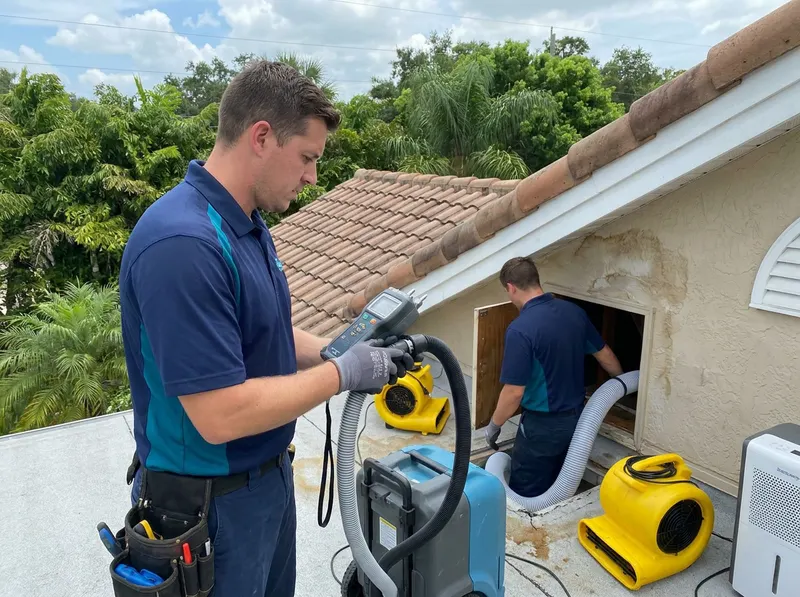
A roof leak differs from a burst pipe because the water enters from above and travels along trusses, so damage often shows up several feet from the actual breach. In Tampa the most common triggers are wind-lifted shingles after summer thunderstorms, aging flat roofs on 1950s-era bungalows in Seminole Heights and Old Seminole Heights, and tile-roof flashing failures common in South Tampa and Palma Ceia. Restoration starts with a moisture meter reading across the ceiling and a thermal check of the attic to trace where water pooled on the drywall's back side, which is usually wet long before a stain appears.
The sequence is straightforward. First, the active leak is stabilized, a tarp or interior catch system stops new water while drying begins. Second, saturated blown-in or batt insulation is bagged and removed, because wet fiberglass loses its R-value and holds moisture against the drywall. Third, sagging or delaminated ceiling drywall is cut back to dry framing. Fourth, air movers and a dehumidifier run on the attic and ceiling cavity for 3-5 days until wood moisture readings drop below roughly 16%. Fifth, an antimicrobial is applied and the ceiling is rebuilt and repainted.
Decision-fit matters because not every ceiling stain needs a full restoration. A small, dry, discolored patch from a leak that has already been roofed over may only need a stain-block primer and paint, a $200-$500 cosmetic fix. Active or recent saturation, spreading brown rings, a bulging ceiling, or a musty attic smell means moisture is still trapped, and drying the cavity is the only way to prevent mold on the wood framing. If the affected area exceeds about 10 square feet or the paper backing of the drywall shows visible growth, Florida guidance treats it as a mold remediation job, which changes the scope. Tampa's humidity is the deciding factor: a leak that would air-dry in a drier climate will grow mold in an unventilated attic within 24-48 hours here.
A point of confusion worth clearing up: roof leak restoration is not roof repair. The restoration crew stops the water and fixes everything inside, insulation, drywall, framing, paint, but the shingles, tiles, or flashing are replaced by a roofing contractor. Homeowners frequently need both, and coordinating them so the interior stays dry while the roof is scheduled prevents a second round of damage.