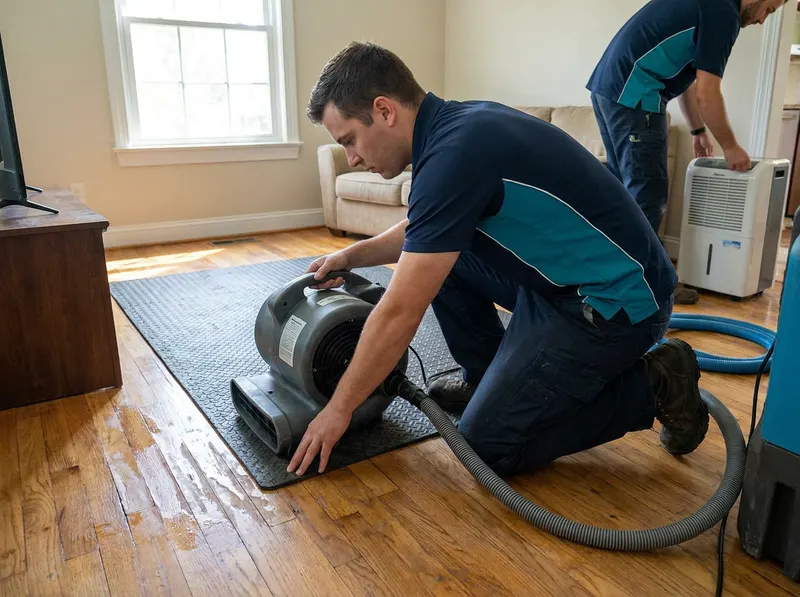
Floor-mat drying works by sealing rubber mats over the wet planks and applying continuous vacuum, pulling moisture up through the finish and joints rather than ripping the floor out. This matters most for solid and engineered hardwood, where a healthy Tampa install sits at 6-9% moisture content and a soaked board can read 20-40%. A moisture meter reading and a baseline off a dry board in the same room decide whether drying is worth attempting.
Decision fit comes down to material and water class. Solid hardwood and quality engineered wood in older Hyde Park bungalows or South Tampa homes usually respond to mat drying if the crew starts within 24-48 hours; wait a week and cupping can set into permanent crowning that only sanding fixes. Laminate is the opposite case, its high-density fiberboard core swells and crumbles once water reaches the seams, so a laminate floor that already shows peaking edges is documented for replacement rather than dried. If the water is clean (Category 1) from a supply line, drying-in-place is the standard path; if it is sewage or long-standing gray water under the boards, sanitation and tear-out usually win.
Tampa's climate is part of the equation. Outdoor humidity often sits at 70-90% here, which is why open windows and box fans do not dry a floor, they feed moisture back into the wood. Sealed low-grain-refrigerant (LGR) dehumidifiers holding the room near 30-40% relative humidity are what actually drive the moisture curve down. Slab-on-grade homes common in Brandon, Riverview, and Town 'N' Country add a wrinkle: moisture can wick up from the concrete, so drying continues until both the wood and the slab surface stabilize.
The process runs in a short sequence. First, meter the wet area and mark the perimeter of elevated readings. Second, place mats or panels over the affected planks and connect the vacuum and dehumidifier. Third, log moisture content daily, a typical Tampa job drops several points per day for the first three days, then slows. Fourth, remove equipment once readings match the dry baseline within 2-4 percentage points and hold steady for 24 hours. Flooring that has moved beyond that point, or engineered planks that have delaminated, is measured and photographed so a repair scope can proceed.